
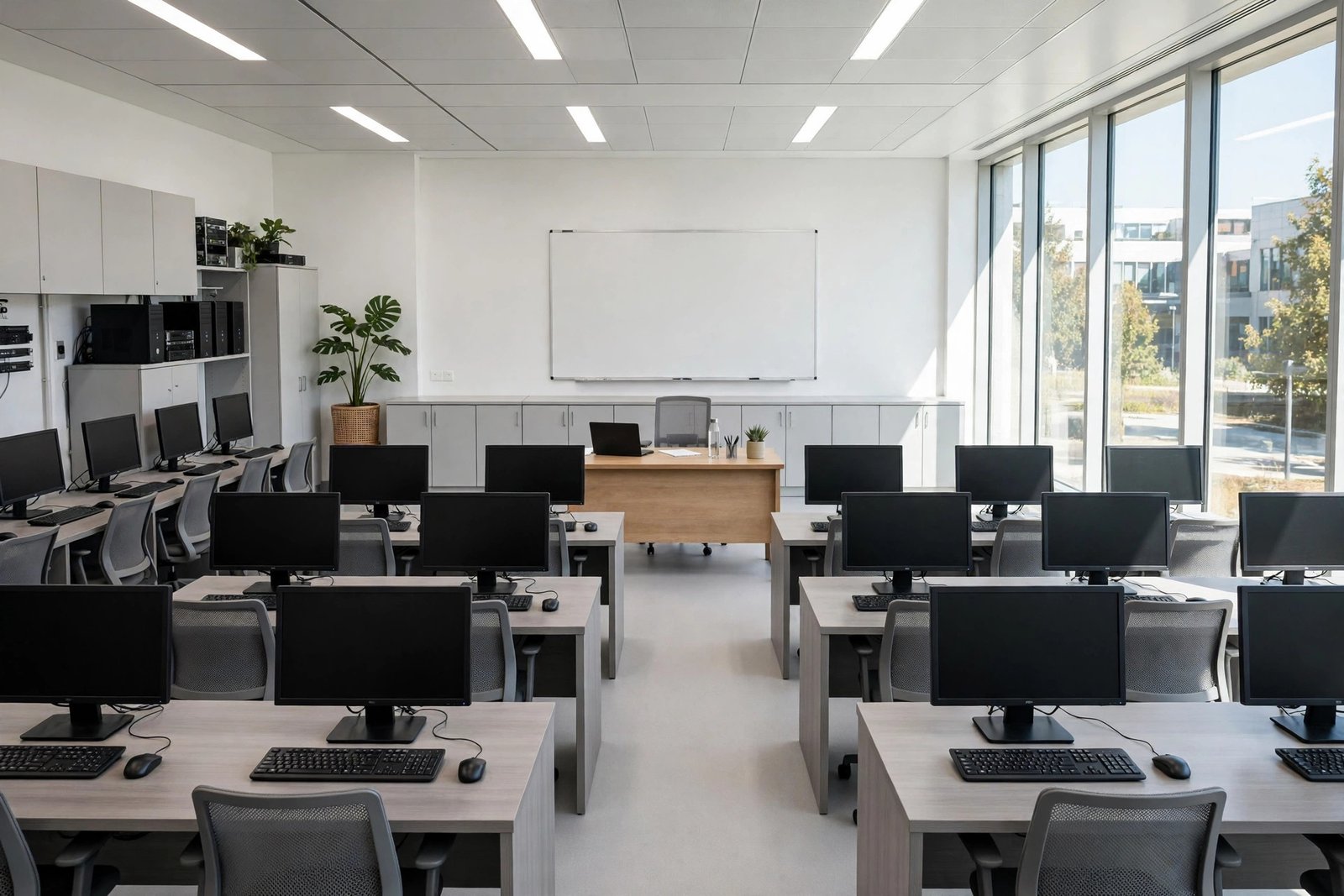
An IT laboratory is a room full of computers, networks, and people learning how technology works. Schools have them, colleges have them, and companies use them to test software before it reaches customers. If you have ever sat at a row of computers in a classroom, you have already been inside one. An it laboratory gives every learner the same safe place to practise.
The idea is simple. Instead of giving everyone a single computer and hoping for the best, you put many machines in one place, connect them to a network, and let people learn, practise, and experiment safely. The lab is where theory meets the keyboard: the place where a lesson about networks becomes a real cable you can plug in and a real problem you can fix.
This guide explains what a lab is, what happens inside one, who uses it, and what makes a good one. Whether you are a student, a teacher, or a business owner thinking about setting one up, you will find a plain answer here.
What Is an IT Laboratory?
An IT laboratory is a dedicated space with computers, networking equipment, and software set up for learning, testing, or research. The word IT stands for information technology, so the lab is built around the tools that store, move, and process information. Every it laboratory follows that same idea, whether it is in a school or a company.
A school lab usually has rows of desktop computers, a teacher’s machine at the front, a projector or smart board, and a printer. The computers are connected to the school network and the internet, and the teacher can watch screens, share lessons, and lock machines when it is time to listen. A company lab looks different: it may have servers, test machines, and equipment for trying out new software before it goes live.
The key point is that a lab is not just a room with computers. It is a controlled space. The machines run the same software, the network is set up on purpose, and someone is in charge of keeping it all working. That control is what makes it useful for learning and testing.
What Happens Inside an IT Laboratory
A typical day in an IT laboratory depends on who is using it. In a school, students practise typing, build presentations, learn to code, or research a topic online. The teacher moves around the room, checks screens, and helps anyone who is stuck. The lab turns a lesson into something hands-on instead of something read from a book. A day in an it laboratory is therefore different from a day in an ordinary classroom.
In a college, the work gets deeper. Students might build a small network, set up a database, or write a program that talks to a server. They can break things safely, because the lab machines can be reset. That freedom to fail is the whole point: you learn more from fixing a broken setup than from reading about a working one.
In a company, a lab is used for testing. Before new software reaches customers, it runs in the lab on machines that match what customers use. Testers try to break it on purpose. If they find a bug, the developers fix it before release. This kind of lab saves companies from embarrassing failures and angry customers.
Whatever the setting, the pattern is the same: a safe place to try, fail, learn, and try again.

Who Uses a Lab Like This?
Students are the most common users. For many young people, the school lab is the first place they touch a real computer. They learn the basics there: how to save a file, how to search safely, how to make a simple document. Those skills follow them into every job they will ever have.
Teachers use the lab to run lessons that would be hard in a normal classroom. A science teacher can show a simulation. A language teacher can play audio clips for each student. A maths teacher can let students test ideas with a spreadsheet instead of a chalkboard.
Businesses use labs too. Software companies test new products. Support teams practise fixing common problems. Training departments teach new staff on machines that match the ones they will use at their desks. Even small companies benefit: a corner of the office with two test computers counts as a lab if it is used for learning and testing.
Researchers are the fourth group. Universities run labs for experiments in networking, security, and artificial intelligence. Some of the biggest computer innovations started in rooms just like these, with a small team and a simple question. If you want to see what those ideas became, read our guide to computer innovations that changed daily life.
What Equipment Does a Lab Need?
A basic lab needs more than a pile of computers. The list below covers the essentials.
Computers come first. Desktops are the usual choice because they are sturdy, easy to repair, and hard to steal. Laptops work too, but they need charging and they wander off. Whatever the choice, every machine should run the same operating system and the same core software, so the teacher is not fixing ten different setups.
Networking comes next. A switch connects the machines, a router connects them to the internet, and cables or Wi-Fi carry the signal. A good lab has fast, stable networking, because a slow connection wastes everyone’s time. If you want to understand the newest wireless standard, read our explainer on how Wi-Fi 7 works.
Software is the third piece. Schools need an office suite, a browser, and whatever subject software the curriculum requires. Coding classes need a code editor. Design classes need graphics tools. The software should be licensed properly and updated regularly.
Finally, a lab needs furniture and power that fit the job: sturdy desks, comfortable chairs, enough sockets, and good lighting. It sounds boring, but a lab where students sit in the dark with dead batteries teaches nobody anything.
How to Keep a Lab Running Well
A lab only works if someone looks after it. The most common reason a school lab fails is not a lack of money. It is a lack of care. Machines gather dust, software goes out of date, and one broken computer becomes three, then five.
The fix is a simple routine. Restart machines regularly. Update software once a month. Keep a list of what is broken and fix the easy things fast. Use one standard setup for every machine so a repair on one machine works on all of them.
Security matters too. Lab computers should have antivirus software, and students should use their own accounts instead of sharing one login. Backups matter as well: if a machine dies, its files should live somewhere safe. A lab that loses student work every term will lose student trust too.
Rules help as well. A short list on the wall works better than a long document nobody reads: no food near keyboards, report a problem instead of hiding it, and save your work often. When students help look after the lab, it lasts longer and works better for everyone.
Frequently Asked Questions
What is an IT laboratory?
A lab is a room with computers, networking equipment, and software set up for learning, testing, or research. Schools use them to teach computer skills, colleges use them for deeper technical work, and companies use them to test software before release.
What is the difference between a lab and a computer room?
There is no strict difference. A computer room is usually just a place with computers. A lab is set up on purpose for learning or testing, with a standard setup, a network, and someone in charge of keeping it working.
Do schools still need an IT laboratory?
Yes, even though many students have phones and laptops. A lab gives every student the same machine, the same software, and a teacher nearby to help. It also gives students a place to practise safely and to try things they cannot do on a locked-down home device.
How many computers should a lab have?
It depends on the class size. A common rule is one computer per student, plus one for the teacher. A lab with too few machines wastes time, because students wait their turn instead of practising.
Can a small business set up an IT laboratory?
Yes. A small lab can be two or three test machines in a corner of the office. The point is to have a safe place to try new software, train staff, and test updates before they reach the machines everyone relies on.
The Bottom Line
An IT laboratory is a simple idea done well: a room where people can learn and test technology without fear of breaking something important. It gives students their first taste of computing, gives teachers a place to run hands-on lessons, and gives companies a safe way to test new ideas before customers see them. That is why an it laboratory remains useful for students, teachers, and companies alike.
A good lab does not need the newest machines. It needs a standard setup, a stable network, working software, and someone who looks after it. Get those four things right, and the lab will serve its users for years. Get them wrong, and the most expensive room in the building becomes a store cupboard full of dead computers. In short, a well-run it laboratory serves its users for years.
- An IT laboratory is a controlled space for learning, testing, and research.
- Schools, colleges, companies, and researchers all use them.
- Standard machines, a stable network, and licensed software are the basics.
- Regular care and simple rules keep a lab working longer than new hardware does.
- The freedom to fail safely is what makes a lab worth having.

1 Comment
Pingback: Tech Driven: 7 Signs a Business Is Tech Driven