
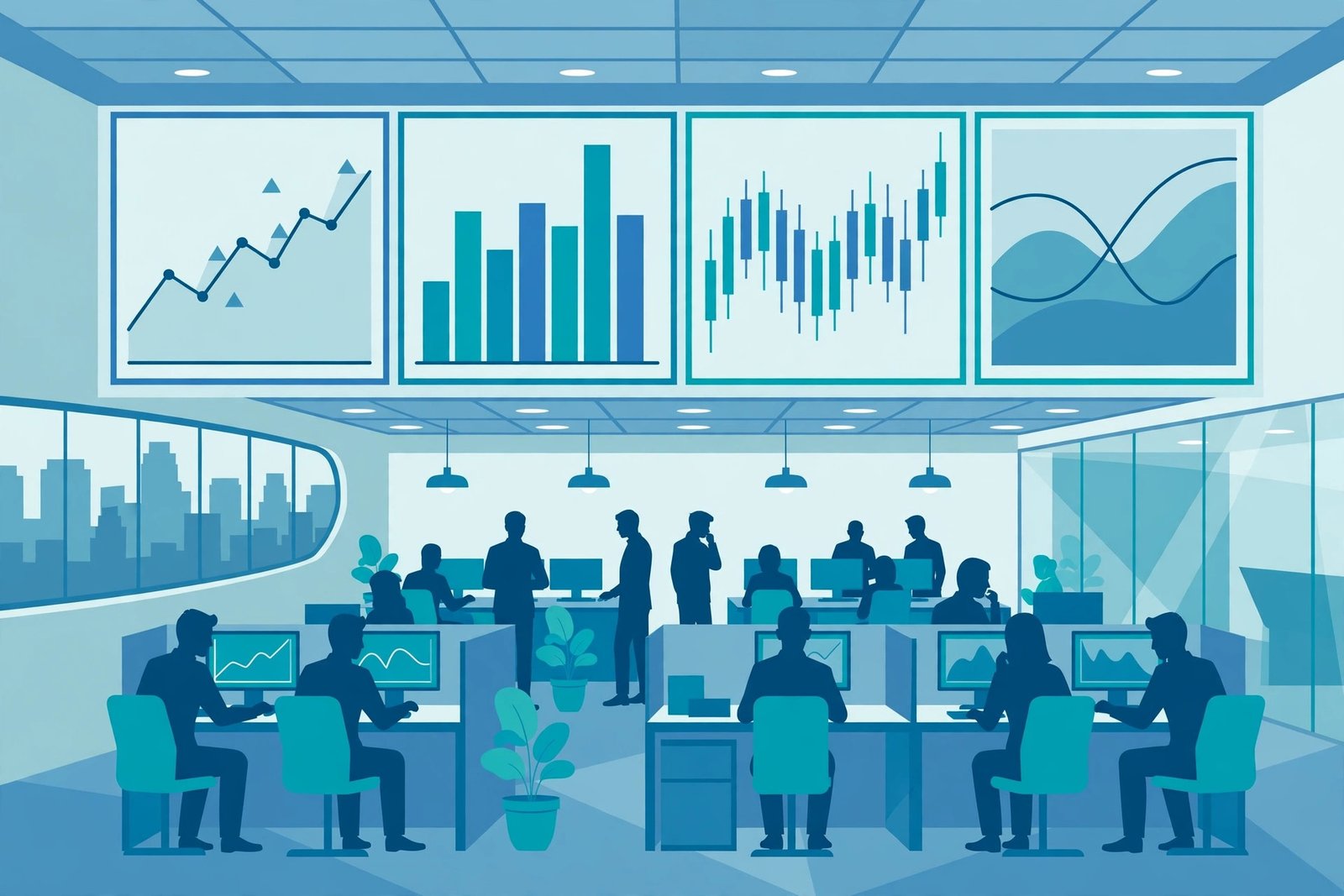
“What are capital markets?” It sounds like a question from a finance exam, but the answer matters to almost everyone. Capital markets are where the money for new factories, new homes, and new companies comes from. They decide how expensive it is for a business to grow and how much return a saver can earn.
Here is the simple answer to what are capital markets: the places — both real and digital — where people and organisations buy and sell long-term investments like shares and bonds. Savers put money in, businesses and governments take money out, and in between, prices are set by supply and demand.
That answer sums up what are capital markets in a single sentence.
This guide explains what capital markets are, how they work, who uses them, and why they matter even if you never buy a single share.
What Are Capital Markets?
Capital markets are markets for long-term finance. When a company wants to build a new plant or a government wants to build a road, it needs a large sum of money for a long time. It can borrow from a bank, or it can go to the capital markets and raise the money directly from investors.
There are two main parts. The primary market is where new securities are first sold — for example, when a company lists its shares for the first time. The secondary market is where those securities are bought and sold afterwards, like a stock exchange. The primary market raises money; the secondary market gives investors a place to sell when they want their money back.
The two big products are shares and bonds. A share is a small piece of ownership in a company. A bond is a loan to a company or government that pays interest. Together, shares and bonds make up most of what trades in capital markets.
Why does this matter to you? Because the money in your pension, your savings account, and your insurance policy is often invested through these markets. When capital markets work well, money flows to good ideas. When they fail, credit dries up and growth stalls.
Shares: Owning a Piece of a Business
When you buy a share, you buy a small slice of a company. If the company does well, the share price may rise and the company may pay you a dividend — a share of its profits. If the company does badly, the share price can fall, and you can lose money.
Shares are bought and sold on stock exchanges. When people ask what are capital markets, shares are usually the first example they hear. Prices change all day as buyers and sellers react to news: profits, new products, interest rates, or even a single comment from a company boss. That constant movement is normal. It is the market doing its job of pricing risk.
Most people do not buy single shares directly. They invest through funds, which pool money from many people and spread it across many companies. That spreads the risk: one company failing hurts less when you own a little of a hundred companies.
That is one simple way to start learning what are capital markets without taking big risks.
Shares are the riskiest part of the capital markets, but over long periods they have usually grown more than safer investments. The catch is the word “usually”. In any single year, shares can fall sharply, and there is no guarantee they will recover quickly.
Bonds: Lending Money for Interest
A bond is simpler than a share. You lend money to a government or a company, and in return you get regular interest payments plus your money back at the end. The borrower gets the cash it needs; you get a steady income.
Government bonds are the safest kind, because governments rarely fail to pay. Corporate bonds pay more interest, because companies are riskier than governments. The riskier the borrower, the higher the interest it must offer — that is the basic rule of bonds.
Short-term government debt has its own corner of the market. Treasury bills are the shortest kind, lasting from a few weeks to a year, and their rates are a benchmark for the whole financial system. Longer bonds, lasting years or decades, are where pension funds and insurers put much of their money.
Bonds are the quieter half of the answer to what are capital markets, but they are the backbone of the system. When bond markets freeze, even healthy companies struggle to borrow, and the effects reach every household.
Who Uses Capital Markets?
To understand what are capital markets, look at who uses them. Companies are the biggest users. A growing firm might sell shares to fund expansion or issue bonds to build a factory. A mature firm might buy back shares or refinance old debt at a better rate.
Governments are the second big user. They sell bonds to fund roads, schools, hospitals, and to cover the gap when spending exceeds tax income. Government bonds are so large and so safe that they set the standard for interest rates everywhere else.
Investors are the third group. Pension funds, insurers, and banks put huge sums into capital markets because they need returns to meet future promises — your pension, your insurance claim. Ordinary savers join in through funds, retirement accounts, and sometimes directly.
Then there are the people who keep the markets running: brokers who match buyers and sellers, exchanges that provide the trading floor, regulators who set the rules, and credit rating agencies that judge how risky a borrower is. Without them, the market would be a free-for-all.

How Prices Are Set in Capital Markets
Prices in capital markets are set by supply and demand, just like any market. If you want to know what are capital markets in practice, watch the prices. If many people want to buy a share and few want to sell, the price rises. If everyone wants to sell, the price falls.
Watching prices is the clearest way to see what are capital markets doing each day.
What drives that demand? News about the company, the wider economy, interest rates, and even mood. When interest rates rise, bonds become more attractive and shares often fall, because future profits are worth less today. When rates fall, the opposite happens.
Expectations matter as much as facts. Markets do not react to what happened; they react to what people think will happen next. A company can report good profits and still see its shares fall if investors expected even better.
This is why markets can seem irrational. They are not a machine; they are millions of people making guesses about the future. Some guesses are smart, some are not, and the price is the average of all of them at that moment.
What Are Capital Markets Good For? Why They Matter to Everyone
You may never buy a share, but capital markets still shape your life. They set the interest rate on your mortgage, because banks price loans against government bond rates. They decide whether your employer can borrow to expand and hire. They fund the pension you will live on.
When capital markets work well, good ideas get funded quickly and cheaply. A new company with a strong plan can raise money in weeks. A government can fund a crisis response without waiting for tax income. Savers can earn a return that beats inflation.
When they work badly, the damage spreads fast. A market crash wipes out savings, freezes lending, and forces businesses to cut jobs. That is why regulators watch these markets closely, and why rules about honesty, disclosure, and fair trading exist.
The lesson is not to fear capital markets but to understand them. They are a tool. Like any tool, they help when used well and hurt when misused.
Understanding what are capital markets is the first step to using that tool well.
Frequently Asked Questions
What are capital markets in simple words?
Capital markets are where long-term investments like shares and bonds are bought and sold. They move money from people who have spare cash to businesses and governments that need it, with prices set by supply and demand.
When people ask what are capital markets, this short answer is a good place to start.
What is the difference between capital markets and money markets?
Capital markets deal with long-term finance — shares and bonds lasting years. Money markets deal with short-term finance — loans and securities lasting days or months. Both are part of the wider financial system, but they serve different needs.
To understand what are capital markets, it helps to compare them with money markets.
Are capital markets safe?
Capital markets carry risk. Shares can fall, bonds can default, and prices swing daily. They are made safer by rules, regulators, and diversification, but no investment in a capital market is risk-free. The safest options, like government bonds, pay the lowest returns.
That is why anyone asking what are capital markets should start by learning the risks first.
Can ordinary people use capital markets?
Yes. Most ordinary people use capital markets through pension funds, savings plans, and investment funds. You can also buy shares or bonds directly through a broker, though it helps to learn the basics — or get licensed advice — before you start.
If you are wondering what are capital markets, your pension fund is a good example of them in action.
Where can I learn more about finance?
Your country’s stock exchange and financial regulator usually publish free beginner guides. For a lighter break, free quiz games on Baamboozle are a fun way to test what you remember.
The Bottom Line
So, what are capital markets? They are the system that moves money from savers to the businesses and governments that need it, through shares and bonds, with prices set by supply and demand.
They fund growth, set the cost of borrowing, and hold much of the world’s savings. They can be volatile and they carry real risk, but a world without them would be one where good ideas struggle to find money and savers earn nothing on their cash.
If you take one thing from this guide, let it be this: you do not need to trade in capital markets to be affected by them. Understanding how they work is one of the most useful things you can learn about money.

1 Comment
Pingback: Managing Money: 7 Easy Habits for 2026